What do I do now?


Now that I had a place to live, the time came for me to figure out how to use my time here. I still wanted to help teach early childhood music somewhere (which is what I came here for in the first place); I just didn't know where. The quest was on, and I set about asking friendly shopkeepers (and they were ALL friendly!) for advice on where to go. I was directed to a local preschool, but I never once was able to connect with the person in charge. One nearby village permitted only the shaman to teach music to young children. Another and then another lead, and nothing was materializing. I soon realized that perhaps this was not what I was supposed to be doing here.

Merri Scott (owner of El Meson) is a very intuitive woman, and she picked right up on my frustration and introduced me to Lucia, a former employee of hers who now works for an NGO funded by the government of Italy. This non-profit (with a ridiculously long acronym I can't remember) funds indigenous arts throughout the world, especially big on funding projects in South America and Africa. Lucia, who spoke no English but was beyond patient with my questions, was most excited that I actually wanted to help. It was with her that I was able to travel to the outlying villages and extend a hand to the incredible people I met there. I hesitate to say "help" because in truth, I was not much help at all. I watched, experimented, copied as best as I could, and loved every minute of it (but sad to say, I really, honestly was almost no help at all!)

As I mentioned previously, Ecuador is full of guild towns. Lucia first took me to a ceramics village called Tunibamba where 7-8 women and 1 man spent one day every week working together in a community workshop with one window and one door and a big kiln outside that was broken for lack of funds to repair it. They were all smiles, loved to crack jokes with each other AND with me when they realized that I spoke enough Spanish to almost understand them. And when they didn't want me to understand them, they switched to their native Quechua, which Lucia didn't even understand. I was given the task of polishing the ceramics (air-dried clay since the kiln was broken). Again, I was little help but I enjoyed my time with them very much.


Another day Lucia and I went way up in the mountains to a town called Morlan in the province of Intag where a small group of women make the traditional fedoras (and occasionally an Indiana Jones hat for the tourists like me).

See a photo of Lucia at the far right.


Nervous about the altitude, I prepared by fasting
prior to the trip (and it was a long bus ride to get there!). For this reason or simply the fact that I was adjusted by then, I had no problems with the altitude. The most interesting thing about this village is that every single woman in the entire place is named Maria. Lucia got a kick out of telling me that it has taken her years to get them all straight, but she calls them all by their middle names: Maria Delores, Maria Elena, Maria Laura, Maria Josefina, etc. Interestingly, however, they call themselves simply Maria. So the Marias taught me how to make hats, and of course I had to buy one for myself before I left. They cackle as they work and were more timid with me than any of the other places I visited during my stay. I don't imagine that many gringos make it up their way. It was as remote a place as I've ever been.

Lucia had a series of meetings as well as supplies to purchase in Quito, so I did not get to spend nearly enough time with her as I would have liked, but I will always be grateful for the opportunity to tag along with her. This was an experience of a lifetime.

Luis and the Villagers


I mentioned Luis earlier (pictured below with his brother-in-law Byron), and it must be said that without his help, my experience in Cotacachi would not have been nearly as wonderful as it was. He speaks incredibly good English for someone who has never formally studied it, and he has a strong desire to speak it perfectly. Watching his corner of the world become a tourist destination has surely not been easy, yet he confided that the only way he can survive is to become a part of it. Like Jose the vet and others who show property "on the side", he charges nothing, just lets it be known that it is customary to give a tip of "whatever you want to pay." Wow, what a concept!

It should be noted that Ecuador is on the dollar, making it far superior to other Latin countries for people like me who struggle with instant conversion of pesos or quetzales or colones. That said, your dollars will go a long way in Ecuador, which for the time being still offers the best value for staples. Unfortunately (or fortunately, depending on how you see it I guess), a number of gringo enterprises have popped up all over Ecuador that compete with locals who struggle desperately to survive in an economy that is tourist driven. The gringo prices are considerably higher of course, but they entice away the tourist dollars promising better quality and service, which is not always the case. As a result, the locals miss out.

Because of his strong desire to help the people in the outlying areas, Luis has formed a small tour guide service in a
ddition to his other ventures, employing his brother-in-law Byron who owns a double-cab four-wheel drive truck to show people around in small groups. He knows he's competing with some large, well-funded, slick, foreign-owned tour operators, but he is far from pretentious when he says he can show you a side of the country that you would never see otherwise.

Luis' tour lasts approximately five hours and
takes very small groups into the homes of indigenous artisans. Invariably, the artisans are rewarded with a sale (or two!) after they demonstrate their craft as Luis narrates in English. Many of these artisans are people Luis has known since childhood, most are old with very limited income, most speak only Quechua, and all are gracious and happy to greet Luis and his tourists and welcome them into their homes. I was lucky enough to go out with Luis and a wonderful couple from Alabama named Ashley and Tim on one of the days I was not with Lucia. Our first stop was in the village of Cara Abuela where the traditional floor mats are made. This is perhaps the most intriguing of all village names in Ecuador as it means "Grandmother's Face" in Spanish.


High on a hill in Cara Abuela overlooking a small lake, we stopped at the home of an old man whose wife had died the year before, and I saw true poverty unlike I've ever seen before. But it was clear why Luis brought us here - old Jose could no longer produce a mat every two days to collect the $3 price that it fetched, so he was without much income. At Luis' command in Quechua, Jose gave us a short demonstration in how to weave the dried reeds from the lake below into floor mats approximately 8 x 10 feet in size (he was only able to complete a short section for us); these serve as the typical indoor carpet in a Quechua home. A tremendous stack of these reeds stood drying in the sun all across the length of his home, giving the impression that he was a bit behind in his process. Ashley and I both immediately picked up on the fact that if we asked to take his picture, it was 'okay' to give him a tip. He did not make much, but it was more than he had seen in awhile according to Luis.

I hesitate to dwell too long on Jose because of the depressing situation he was in, but it was fascinating to me to see the difference in the generations of the indigenous population as the Cotacachi area has grown and begun to change from the very ancient Quechua traditions to the new world of dollars and tourists and "progress." Old Jose lives in a crumbling adobe, well over 100 years old, one room with a dirt floor, no windows and no light but for the wide doorway. Though the demonstration of mat making was held on his "patio" (a term I use very loosely), Luis insisted we take a look inside the adobe. There, amidst a single cot on one side of the room and a cooking campfire ringed with stones on the other, eight or ten guinea pigs ran all about. All different sizes, perhaps from different litters but all the same stock, these guineas are the traditional food of the old Indian. Though I was aware that the traditional diet centered around roasted guineas, I was unprepared for the sight. Luis explained that when he gets hungry, he simply throws one on the fire. (I was too mortified to ask if he bothers to kill it first.) Note: I had to adjust my camera to get enough light to photograph inside here.

It was clear that Jose had almost nothing else, not even clean water - unless it was delivered to him by a neighbor. Now too old to do much else, he produces approximately one mat per week, making his annual income around $156.

Much
later in the day, I asked Luis more about Jose and if he is typical. "No," he said, "most have families that take care of them, but he had no children." And the diet? "Only the old people still eat that way. I am Quechua, and I will not eat that. It's nothing but a rat." I was relieved to hear that.


Moving on, we came to a small village of weavers (I can't recall the name). This village sits right on the lake where grow the reeds that Jose uses for his mats, so I was a bit surprised that this one was not the mat-making village instead of Cara Abuela. But after a bit of thought, it made perfect sense: the humidity in and around the lake would prevent the reeds from drying while the wind on the hill above would only aid in the process. These people have centuries of common sense at their disposal, so of course, I should have known!


The artisan family we visited here (four generations under one roof) produce beautiful shawls and belts, tightly woven, some with exotic, shiny threads that are surely imported, but plant-dyed cotton and wool from Ecuador were the most common. Surrounded by her weaver-son and her many grandchildren, the woman was happy to weave all day, stopping only to sell us a few shawls. Employing a large floor loom that looked to be handmade, the son worked on the shawls while she sat on the floor with a belt loom that was tied to her waist providing the tension.


Next up was another village that is known for its weaving but that happens to have one of the most famous instrument maker families in the country in its midst. Peguche is almost a suburb of the large market town called Otovalo and is easily accessible off the Pan-Am Highway. We happened to come along just as a little concert was underway for a group of German tourists. Though we would have asked a lot more questions if we had not been interrupting something in progress, we learned that the mandolin-type instruments on the wall are made of armadillo shells, the shakers from sheep's feet, the pan flutes come from a type of local bamboo, and the guitars are handmade right there in the taller (workshop) attached to the house. The musicians sounded great, playing Andean traditional tunes, first instrumental only but then adding vocals sung in Quechua; they offered several CDs for sale which the Germans quickly bought up. As we were leaving I noticed an array of orchids hanging from the porch - the guitar player told me that the orchids are his hobby. (He's really good at it!)


On to another village whose name escapes me, this time to visit a couple
who have been weaving and spinning together for 70 years (they met at the age of 7). Take one look at them and you'll see why they were mesmerizing. LOVELY couple whose spirits filled the place and the hearts of ALL their visitors I'm quite sure.

Having always thought that alpaca wool was a product of Ecuador, I was surprised to learn that all the alpaca actually is raised exclusively in Peru. Ecuador is sheep country, and this couple has spent their entire lives shearing, carding, spinning, and weaving. Their handiwork dotted the workshop, all sorts of rugs and scarves and artistic creations. Again, how can you leave here and not support them? Ashley, Tim, and I bought at least one item each. (I can't imagine being able to afford to shop like this on any other type of tour - nor would it have ever been of benefit to the artisans themselves.) Part of the demonstration included the use of a type of cactus grown in the area used to comb the wool and soften it while it was still on the loom. I was fascinated by that bit of ingenuity, and Jose (yes, another Jose) picked up on the question. Not knowing that he spoke Spanish, I was surprised when he engaged me in conversation on the way out asking if I would like to see his small garden. He offered me beans right off the plant, and pointed to his crop of corn and quinoa to the side of the house. The smiles of this couple will forever stick with me. If nothing else had happened, I would have left Ecuador very happy.


On to Peguche Falls, an absolutely beautiful park-like setting that happens to be protected ancestral land of the Quechua. Many shamanic ceremonies have been held here over the centuries with the sound of the falls as background music. The trees are taller here, and the forest-like feel of the place was unique to this part of Ecuador. We saw school kids there looking at the flora and fauna, couples romancing, families on picnic, and a young couple brave enough to climb to the top of the falls and perch above all the rest of us like Andean gods surveying their pastoral heaven.

Clearly, this part of our little tour was a nature-lov
ers' dream, and it gave me a thrill to pick up on Luis' sense of pride as he showed us this beautiful spot. We learned that the waters that spring from the earth here are considered sacred, and many Quechua come here to fill up jugs for drinking. Gardens dot the few open areas as well, benefiting from the humidity and the rich humous provided by the year round magical forest biology. More carefully tended than most I saw, the caretakers were growing quite a lot of greens and berries, crops that I did not see so frequently elsewhere.

As you leave the Falls area, a group of vendors line the exit in wait for the tourists, selling bracelets, rugs, lamps, textiles, and sweet roasted corn. I caught some quinoa drying in the sun as we left, more colorful than any I had seen so I had to get a photo.

We headed into Cotacach
i for lunch, met up with Tim's brother Kerry - one of my renter friends - and had a wonderful time rehashing the day. (It should be noted that the tour was not really over as all but me went up to Lake Cuicocha after lunch.) It was during our meal that I learned that Byron understood every word we had said all day (I was trying so hard to include him in Spanish!) ... he explained to me he doesn't try to speak English because he doesn't have the accent right and is unsure of his vocabulary, but that he can understand it. I have a feeling this is probably true of a lot of the Quechua people in and around Cotacacachi. They should not be underestimated!

From left: Tim, Ashley, Kerry, Luis, Byron

Traveling Alone You're Never Alone


El Meson de las Flores figures prominently into life in Cotacachi for all the foreigners that come through in addition to those that come and don't leave. As the only hotel (aka "hostel") in town with wireless internet plus delicious menu and friendly staff, it's hard to stay away once you discover it. Known as THE spot for the gringos, local artists exhibit their wares there during hotel sponsored "ferias", musicians stage concerts and/or casually entertain during lunch, and traditional dancers (as well as some very non-traditional gringo dancers!) fill the courtyard on some nights when the hotel is full. I think my social life there was about 110 times more active than it is at home. I was exhausted much of the time but had o soo much fun!


The large picture of the beautiful 7 yr old at right
is of Pacha Lucia whose Quechua family, including her little brother on her back, would come into town to the ferias at the hotel. I honestly think the gringos gave her more money in tips for being cute than her parents made selling their wares (can't blame them!) As an aside, "Pacha" means "earth" in Quechua, and many names begin with it; thus translated it becomes Lucia of the Earth.


Pictured here are some of the dancers and musicians that performed at El Meson. The boys at right are part of the Cooperativo which you will read about below.


As a result of a yahoo group (which I heartily recommend joining in advance of a plan to visit ANY foreign country), I met a Canadian woman who introduced me to a Cooperative that makes leather and crochet goods for export. (She is one of their main clients.) There is some overlap in the cooperative members that do leather and crochet and the boys that play in the band, but they are generally all in the 15-30 age group and all are male. I was invited to hear their band play one night in their very small work space, and no one was as surprised as I was to learn that I was the only invited guest to their little in-house concert. Fortunately I persuaded a friend I had made who was staying at the hotel to go with me, but unfortunately (or perhaps not!) I didn't get pictures that night because, despite the space limitations, we had an Andean Conga line (I think I just made that up that term!) circling around their tiny living room.


Pictured here with the flute is Raul (above), Manuel at left and Freddy below. Raul and his brother Faust were the oldest and the unofficial leaders of the group. Their many members wandered in and out during the day, stopping to do a little crochet or leather work when they had some time.

I commissioned Faust and his brother Raul, whose very humble little home served as HQ for the Cooperativo, to make some guitar straps for me with the hope of finding them a market back in Texas. So far, sad to say, no luck on that count as the economy is so bad that nobody is buying right now. (Anybody need a handmade leather and crochet work-of-art guitar strap?)


I happened to be in Cotacachi when International Living's Dan Prescher and Suzan Haskins came up for a few days at the tail end of one of their large conferences in Quito. It was a treat to meet them anyway, but the REAL plus for this old musician was discovering that Dan is a musician and has a repertoire big as Texas. He played and sang to a packed Meson house one evening (yours truly had the pleasure of singing a couple as well) and blew us all away with his talent and the variety of his songs, everything from John Prine to John Denver. (The photo here was taken by a fantastic photographer named Dennis Goff; more on Dennis and his beautiful wife Nicki in the links at the end.)

Plenty of gringos (defined loosely as foreigners who speak English) are living in Cotacachi, some renting, some having bought land and built some really nice homes. Many of them live there on a part-time basis though some have bought homes and rent them out during the times they are not in residence. Near my little apartment was a gated community called San Miguel and another one nearby developed by an Ecuadorian woman-architect and builder. Near the outskirts was yet another nice one, plus at least 2 large condo developments under construction with no paucity of buyers in the wings. It goes without saying that the ex-pats love to get together, so there is ample opportunity for those who don't speak Spanish to socialize to the heart's content.


I would be remiss if I did not mention the shopkeepers with whom I became acquainted. Too numerous to mention them all, but Eva who sells jewelry and leather jackets stands out (pictured here), and I will always consider her a great friend. She would emerge from behind her counter whenever I passed by to give me the traditional peck on the cheek and ask me how I was doing.


Great restaurants do not abound in Cotacachi (it's too small!), but besides the great food at El Meson de las Flores, there are 2-3 that are outstanding. Susanna (at left) makes the best pizza in the world (and I mean ANYWHERE I've been!) Her small restaurant called Flavours and Colours (yes, it's in English) is a work of art. Having been designed, built and decorated (down to the art on the walls) by her talented student-son who comes home on the weekends from the university, Susannah's 8 tables are always full!
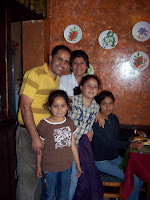
Anita and her husband Hector and two adorable girls (pictured here with an equally adorable cousin) own D'Anita's, another favorite of locals as well as tourists. During my sicko episode, Anita made me a huge pot of tea (special recipe she said) and insisted I take the whole fancy teapot back to the hotel with me. Not a worry in the world that she might not get it back. I think everyone in town agrees that she is an angel from Heaven. Her restaurant is also small and also always full!


So many more I wish I had gotten pictures of: Gido the cashmere and leather seamster, Juan Carlos the aloe vera vendor, Gladys and Juan, the lovely couple that I would see regularly on the street who invited me to their house for tea, Jota, the 20-something who runs one of the many internet shops. And I must not forget Sandra who sold me a handmade Cotacachi guitar. Thankfully I did get a good photo of Sandra, pictured here (on the left) with one of her friends at an outdoor concert.


And speaking of concerts and outdoor gatherings, whew, there was something every weekend! Cotacachi's indigenous mayor is big on street parties, and at least twice during my stay there were large concerts in front of the mayoral complex. Sandra's husband was one of the conductors this concert day (and is also a musician of the highest order!).

As I mentioned earlier, these kids, in
digenous and Ecuadorian alik
e, have access to quality music education from an early age. I'm not sure we can say that any longer in the U.S. since so many music programs have been cut from our public schools.

The high schoolers performed with another band and an area orchestra on
this day, and all three groups were first class.


It happened that Ecuador's Election Day was coming up (very shortly after I left), so campaigns were in full swing. Despite a horrific downpour one day, the mayoral candidates held rallies on the main square that drew hundreds of spectators. With lots of music, speeches, laughter, and plenty of attention from the electorate, it seemed much more of a party than a campaign event. Unlike in the U.S., the population takes great interest in elections here, and voter turnout is very high.

All in all, never a dull moment.

Kenji's Garden


The day I spent with Kenji, the 25 yr old Peace Corps volunteer from the east coast of the U.S. was memorable enough to warrant its own blog entry. I had met him on a bus tour with the Scotts who were kind enough to invite me along knowing that I have an intense interest in food production and sustainability as well as indigenous culture. Kenji provided an excellent overview of what he's doing there with the Peace Corps, and I immediately wanted to see if I could fit in here and help somehow. (Again, I was not much help, but I had fun anyway!)


Recognizing the demise of indigenous food crops in the area, Kenji's project in Ecuador revolves around resurrecting knowledge of indigenous plants that grow all over the country. With some limitation because of the elevation, this one garden attempts to grow crops and save seed that have provided sustenance to generations of Ecuadorian and Quechua peoples. The Peace Corps project employs two full time local workers who do most of the maintenance in the garden, but volunteers are welcome.


So...after the formal tour I made arrangements to meet him one day and work in the garden; I know he was a bit disappointed that I was the only one, but he was gracious to take the time to spend telling me what to do (sometimes more work than it's worth as most project overseers are well aware) as this is one busy young man!

On the day we agreed to meet, he h
ad forgotten that he had to film a parade for the video he was going to produce as part of his project. Part of the garden's objective is water awareness: water rights, pollution issues, flow, treatment, health benefits, etc. During his time there, he had become a fixture in the schools and the local government raising awareness of water issues. This day was the culmination and celebration of a lengthy study by the schoolchildren who were given the day off to participate in the big Water Awareness Parade, march through the streets and make sure that those who were not present in the schools were also made aware of the importance of water. I was more than happy to tag along while he filmed and learn more.


See "the little squirts" at left (Kenji's term for the little water droplets, signifying to them that each one is important and must be taken care of).

The parade ended at a non-profit institute on one side of town that housed an organization that had sprung up as a result of Kenji's work. Sumak Jambina collects, dries, packages and sells herbal preparations made from the plants in what I came to call "Kenji's Garden."


All natural and all indi
genous to the area, these herbal preparations are made into medicinal teas or salves that have been used for centuries. I was in heaven learning about them from a colleague of Lucia's whom I learned worked in tandem with this non-profit. In fact, all the non-profits seem to share a working arrangement that seems to ensure the success of their stated goals. All is one and one is all - I saw no rivalry among these groups, only cooperation and camaraderie just as I saw on a more personal level among the members of the cooperativos.

A little Tourist Stop on the Way to the Garden:

As we were leaving the parade participants and Sumak Jambina to walk out to the garden a couple of kilometers outside of town, we decided to cut through a property that I had been curious about - and apparently so had Kenji. The Mirage Spa seems a bit out of place in Cotacachi with a night's lodging costing more than the yearly wages of some of its laborers.


I admit to a bias against it for its class-ist opulence that was out of reach of so many -- including
me, but plenty of my new friends had dined there and loved it. And I mean "dined," feasted, celebrated food and good taste and good service... so I guess I should have included it in the section about local restaurants. But since I never ate there myself (because one meal would have cost me more than I would spend otherwise in a couple weeks), I cannot personally say. But you should know that it is HIGHLY recommended and even appears in a book entitled 1000 Places to See Before You Die. Hmmm, right there in little Cotacachi!


Kenji snapped as many photos as I did so he could send them home to his
family, and then we headed on out to the garden. By this time it was just past high noon, and it was a long walk. No sign of the normal cloud buildup on this day. He was thinking of me I'm quite certain when he said we couldn't work very long due to the hot sun and the heat of the day. And he was right - I hoed weeds and chatted alongside him for only about an hour. And man, was I ever sunburned when it was all over! Too pooped to pop, I had to forego a concert by "Jose the Taxi Driver and Mayor of Quiroga" at the home of some gringo friends because I couldn't keep my eyes open past 7 p.m.! It was worth it.